
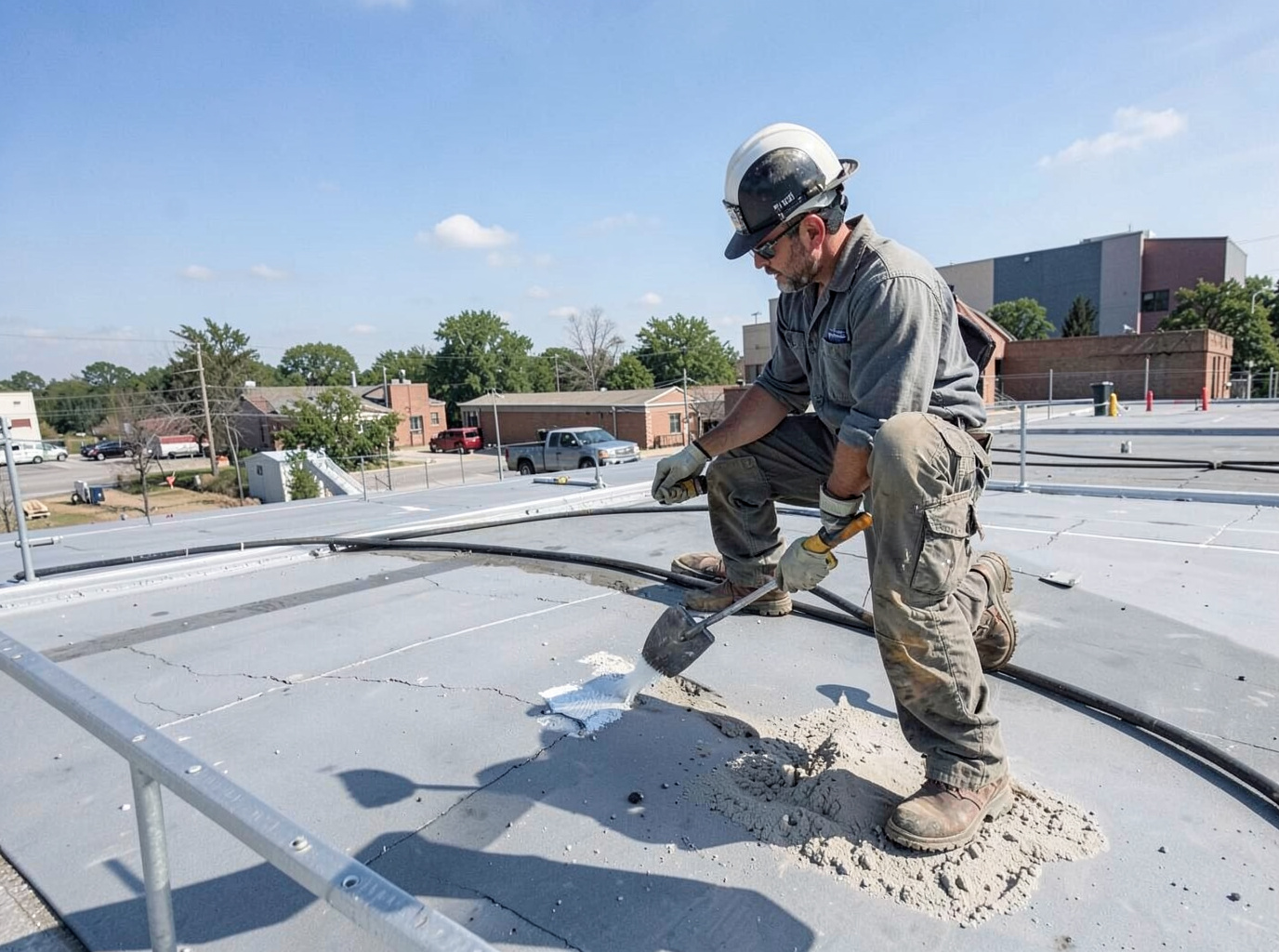
Longview commercial buildings often carry 20- to 40-year-old modified bitumen or EPDM roofs installed when the Pine Tree and Judson corridors developed. Hot humid summers drive constant thermal expansion while sudden thunderstorms create ponding at scuppers and drains that were never sized for the region's rainfall intensity. These conditions blister seams and soften adhesives long before visible leaks appear.
Repairs start with infrared moisture mapping to locate wet insulation without tearing the entire deck. Technicians then cut out saturated sections, install tapered crickets to restore positive drainage, and heat-weld new membrane patches that tie into existing flashings at HVAC curbs and parapets. Edge cases include 1960s-era gravel-surfaced roofs near the Alley-Carlson House where aggregate must be removed before any heat application.
Gregg County permitting requires wind-uplift ratings on any patch larger than 100 square feet. Crews also verify that new coatings meet the updated energy code for reflectance when working on buildings along Eastman Road or near Longview Mall. Skipping these steps risks failed inspections and insurance denials after the next storm.
Work in nearby Kilgore, Marshall, Gladewater and White Oak follows the same protocol but adds travel buffers because crews often handle multiple sites in one day when thunderstorm cells move through the county.
Technician insight
In Longview the thing that catches most people out with Commercial Flat Roof Repair is how quickly humid summers soften the adhesive on older modified bitumen roofs along Eastman Road; a small seam lift after one thunderstorm turns into a full insulation replacement if you wait until the next inspection cycle.
Ponding at North Longview Office Roof
Standing water collected at two scuppers on a 1987 EPDM roof serving a medical office near North Longview. Infrared showed saturated insulation extending six feet inward from the parapet. Crews removed the wet material, added a secondary drain and installed a new tapered patch that tied into the existing membrane. The roof has remained dry through two thunderstorm seasons.
Commercial Flat Roof Repair Services We Offer
✓TPO Membrane Patch Repairs
Heat-welded patches restore watertight integrity on commercial TPO roofs damaged by standing water common after Longview thunderstorms.
✓EPDM Seam Restoration
Adhesive and tape seam repairs prevent wind-driven rain from entering along field seams on older EPDM systems found throughout Pine Tree and Spring Hill.
✓Drainage Improvement and Scupper Work
Installation of additional drains or modified scuppers eliminates ponding on flat roofs serving Downtown Longview retail and office buildings.
✓Modified Bitumen Flashings
Replacement of deteriorated base flashings around HVAC units and parapets stops chronic leaks on 1980s-era roofs in the Judson and North Longview corridors.
✓Coating Over Existing Membrane
High-solids acrylic or silicone coatings extend service life on sound but weathered commercial flat roofs without full replacement.
✓Wet Insulation Removal and Deck Repair
Targeted tear-out of moisture-damaged insulation followed by deck restoration prevents mold growth and structural issues in humid Gregg County conditions.
Commercial Flat Roof Repair Cost in Longview, TX
| Service | Typical Range | What Affects It |
|---|---|---|
| Infrared moisture scan and report | $350–$650 | Larger roofs or multi-story buildings in Downtown Longview increase cost. |
| Single TPO or EPDM patch under 100 sq ft | $800–$1,400 | Includes insulation replacement and seam testing. |
| Drainage scupper addition | $1,200–$2,100 | Depends on deck type and parapet height. |
| Full roof coating per square | $1.80–$3.20 | Price varies with surface prep needs after thunderstorm damage. |
| Wet insulation removal and deck repair | $4–$9 per sq ft | Higher end applies when structural decking must be replaced. |
Ranges are typical for Longview, TX and confirmed with an exact written quote before any work starts.
How it works
- 1
On-Site Assessment
Technician performs infrared scan and core cuts to map wet areas and evaluate existing membrane type and attachment on the Longview property.
- 2
Scope and Material Selection
Detailed repair plan identifies patch locations, drainage fixes and coating options that match the building's age and roof system.
- 3
Repair Execution
Crews remove damaged sections, install new membrane or flashings, and restore positive slope before sealing all seams to manufacturer standards.
- 4
Final Walk and Documentation
Owner receives photos, moisture readings and a maintenance checklist before crews leave the site.
Pricing
Upfront written quotes after inspection; final price depends on roof access, membrane type and square footage of wet areas.